|  |  |  Fundamental objectives for the Family and Public Programs: Fundamental objectives for the Family and Public Programs:
- Leverage student excitement created by the Classroom Visits by providing researcher-led programs for these students and their families that: engage parents in the education of their children; foster educational conversations between parent and child for weeks after the program; and build a bridge between the schools and the public they serve.
- Provide presentations that in general are relevant to the science curriculum, and in particular address what we know about Earth’s place in space and how we have come to know it.
- Assess the concept of a science program for family learning, and whether families in the community have had such experiences.
- Assess the effectiveness of the program in terms of education value, entertainment value, and shared family experience.
- Determine if the program changes perceptions in both adults and children regarding science and scientists, science education, and space exploration.
|  | Adult and student questionnaires are handed out after the program in self-addressed envelopes. Local Team members, and the Visiting Researcher during his/her presentation, stress the importance of families taking the time to fill out and return the questionnaires. In fact filling out the questionnaires as a family can be a fun experience, and spark conversations about the shared experience of the program. 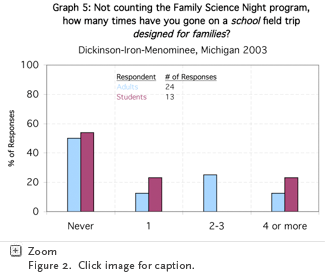 The questionnaires request age and gender information, allowing differences in perspective to be discerned between e.g., adult men and women, between boys and girls, or between younger and older groups. The questionnaires request age and gender information, allowing differences in perspective to be discerned between e.g., adult men and women, between boys and girls, or between younger and older groups. Download the Family and Public Programs Questionnaires
The questionnaires reflect a ‘Family Science Night’ format for the program. For Adults (PDF, 140 kb)
For Students (PDF, 140 kb) On receipt of the questionnaires, all quantitative data and all comments are entered into a database and a Family and Public Programs assessment report is generated. Samples of the quantitative analysis portion of the report, reflecting programming in five communities, are provided in graphical format at the bottom of this page. | | |  | Two ‘calibration’ questions are asked of both adults and students: - How often do you go on educational trips as a family?
- Is science education as important as “reading, writing, and arithmetic”?
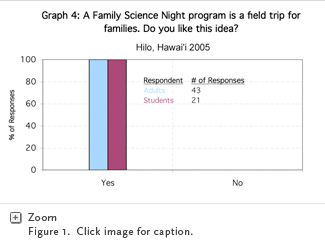
Overwhelmingly, and consistently, both adults and students indicate that science education is as important as reading, writing, and arithmetic (see downloadable assessment reports at the bottom of the page). An argument can be made, however, that science isn’t as important given the latter three are fundamental ‘language’ skills, all of 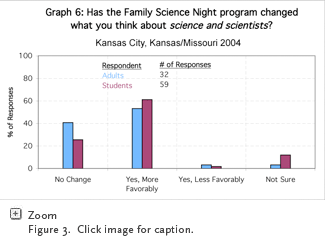 which are required of good researchers. Mathematics is the language of nature, and enables science. Reading and writing enable communication between researchers, and between researchers and the greater public. Nevertheless, science education is deemed important by attendees of these programs. which are required of good researchers. Mathematics is the language of nature, and enables science. Reading and writing enable communication between researchers, and between researchers and the greater public. Nevertheless, science education is deemed important by attendees of these programs. Also consistent from program to program, attendees indicate that they go on educational field trips as a family ‘occasionally’ as opposed to ‘frequently’ or ‘almost never’. There is therefore a not too surprising selection effect in that these audiences have a predisposition to attend a family program in science education. One can therefore question whether such programs can lead to positive perspective changes about science and science education in these audiences—which is one of the assessed objectives of the Family and Public Programming. | | |  | Two questions are asked of both adults and students regarding the concept of educational programming for families: - A Family Science Night program is a field trip for families. Do you like this idea?
- Not counting the Family Science Night program, how many times have you gone on a school field trip designed for families?
Results shown in Figure 1 and Figure 2 are representative of assessment in all communities. Programs designed for family learning are clearly appreciated by these audiences. Figure 2, however, points to an opportunity, and the ability for Journey through the Universe programming to address it. 50% of the audience—both adults and students—feel they have never attended a school field trip designed for families. It is a program format that provides schools the opportunity to engage parents in the education of their children. | | |  | Three questions are asked of both adults and students concerning the program’s impact on their perceptions: Has the Family Science Night program changed what you think— - about science and scientists?
- about science education?
- about space exploration?
- Comment field: How?
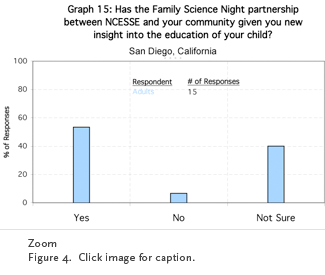 Figure 3 is representative of responses to all three questions, and a representative response across all communities. It indicates that for approximately 50% of attendees the program has led to a more favorable perception in these three areas, with students always slightly higher in this perception than adults. Even audiences with a predisposition to think that science education is important feel changed by this program. It is borne out not just by these data, but by the comments provided on the questionnaires. Figure 3 is representative of responses to all three questions, and a representative response across all communities. It indicates that for approximately 50% of attendees the program has led to a more favorable perception in these three areas, with students always slightly higher in this perception than adults. Even audiences with a predisposition to think that science education is important feel changed by this program. It is borne out not just by these data, but by the comments provided on the questionnaires.
At the dozens of family programs held at the National Air and Space Museum (NASM) attendees indicated the same level of perspective shift. This is remarkable given that an added calibration question for NASM attendees determined that the average attendee had been to the Museum four or more times. What was it about this program that was different than the other experiences they had at NASM? Most visitors to informal science education settings have passive experiences, e.g., walking through galleries full of artifacts—full of things—that are clearly associated with powerful human stories of exploration, yet the stories are either told in a passive way through storyboards, or in most instances not at all, with storyboards simply providing a collection of facts and information. But science is about empowering oneself to ask a question of the world and persevere to an answer. Science is not so much about the new knowledge at the end of the road. It is about the very human journey to get there. And you need a human—one who’s been to the end of the road—to tell you what it was like and why those artifacts are so important. The centerpiece of the Journey through the Universe Family and Public Program is a personal story by a researcher gifted at bringing the audience into the story. It is a powerful means of humanizing science and making it real. Stepping back from the experience, attendees recognize that this was science education—and it was fun and exciting. The assessment also indicates that positive perspective changes in women were higher than those in men. Many women were in attendance because it was a ‘family’ function, yet viewed science, and certainly space science, as ‘boys and their toys’. A common comment by women on the questionnaire was that they had no idea science could be so exciting. At the end of the program, students typically crowd the researcher to get an autograph—an autograph not from a star athlete or a musician or an actor, but from an astrophysicist, or a planetary geologist, or an engineer. This program transforms researchers into heroes to a next generation. | | |  | 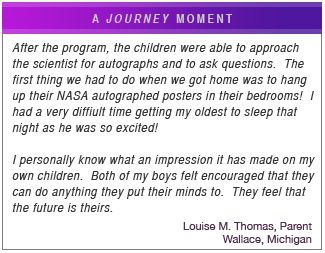 Three questions are specifically addressed to adults: Three questions are specifically addressed to adults:
- Do you think the Family Science Night program has affected your child? How?
Typical response: 90% of adults say yes, with comments similar to the quote from Louise Thomas. - Has the Family Science Night experience led to educational discussions between you and your child?
Typical response: 60-80% of adults say yes, with the vast majority of the other respondents saying they have not had an opportunity yet. - Has the Family Science Night partnership between NCESSE [the National Center for Earth and Space Science Education] and your community given you new insight into the education of you child?
Figure 4 provides a typical response: at least 50% of adults say yes. |  | 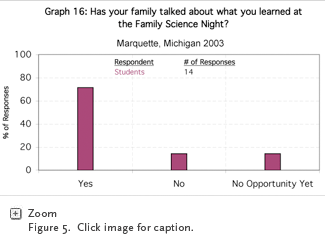 Three questions are specifically addressed to students: Three questions are specifically addressed to students:
- Do you think the adults that came with you liked the Family Science Night program?
Typical response: 80-100% say yes. - Has your family talked about what you learned at the Family Science Night?
A significant variation in response is seen across communities, with 40-80% of respondents saying yes. The majority of the other respondents say there was ‘no opportunity yet.’ Figure 5 represents a program in Marquette, Michigan. - Did the information you learned at the Family Science Night have anything to do with what you’re learning in school?
Typical response: 50-80% say yes. In communities that choose to target grades K-12 with their Journey through the Universe program, as a means of exposing all students to the process of science, the content focus in Earth and space science will not overlap the curriculum at every grade level. For those communities that target specific grade levels where the Earth and space science curriculum has significant overlap, family programs will still include siblings in other grade levels. Download Sample Family and Public Programs Assessment Reports Dickinson/Iron/Menominee, Michigan, 2003 (PDF, 50 KB)
San Diego, California, 2003 (PDF, 50 KB)
Marquette, Michigan, 2003 (PDF, 50 KB)
Kansas City, Kansas/Missouri, 2004 (PDF, 55 KB)
Hilo, Hawai'i, 2005 (PDF, 70 KB) | | |