| |  |  | 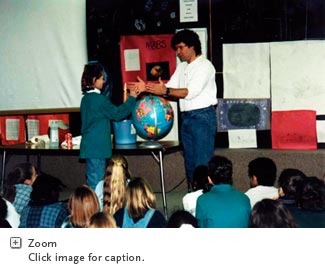 The Classroom Visits conducted by the Visiting Researchers are capable of providing thousands of students in your community an opportunity to hear firsthand about the true nature of science and exploration. They travel to your community from research organizations across the nation. The researchers place their research experience within the context of the scientific process—resulting in a wondrously personal story of discovery. The researchers address: the questions they are asking of the universe, why those questions are particularly interesting to them, how they framed an experimental pathway to an answer, the teamwork that is often required to carry out their investigation, what they learned at the end of their journey, why that’s important, how it felt to possibly see something wholly new to the human race, and the new set of questions—the new explorations—launched by what they found. The researchers then provide the story of their personal path to the frontier—how they got inspired, and the choices in education that they made and why—and advice for those in the audience interested in STEM disciplines. Students should be able to view these researchers as role models—even heroes. The Classroom Visits conducted by the Visiting Researchers are capable of providing thousands of students in your community an opportunity to hear firsthand about the true nature of science and exploration. They travel to your community from research organizations across the nation. The researchers place their research experience within the context of the scientific process—resulting in a wondrously personal story of discovery. The researchers address: the questions they are asking of the universe, why those questions are particularly interesting to them, how they framed an experimental pathway to an answer, the teamwork that is often required to carry out their investigation, what they learned at the end of their journey, why that’s important, how it felt to possibly see something wholly new to the human race, and the new set of questions—the new explorations—launched by what they found. The researchers then provide the story of their personal path to the frontier—how they got inspired, and the choices in education that they made and why—and advice for those in the audience interested in STEM disciplines. Students should be able to view these researchers as role models—even heroes. To help tell these stories the researchers often bring artifacts and concrete manipulatives, supplies to conduct a relevant hands-on activity or demonstration, and multimedia presentations. The Visiting Researchers are fully briefed on expectations for their Classroom Visit presentations when applying for, and being accepted into the program, and again as part of their briefing package for the upcoming academic year. | | |  | - The Visiting Researcher must operate outside of ‘lecture mode’ and engage audiences through audience participation.
- The Visiting Researcher must make science concepts, general content, and the process of science understandable by building bridges to the familiar (using vocabulary and experiences that are familiar to the students.)
- The Visiting Researcher is to design presentations that relate to their research—their personal story—and that connect to the curriculum through relevant grade K-12 national science education standards.
- The Visiting Researcher is to provide an understanding of their personal career path, and more generally, the subjects and disciplines of importance to students interested in a research career.
The National Center for Earth and Space Science Education conducts assessment of the Classroom Visit component of Journey through the Universe program. | | |  | | We define ‘Classroom Visits’ in broad terms, allowing you to tailor presentations to both traditional and non-traditional audiences and venues. This approach truly allows your entire community to be engaged in a Journey through the Universe. Some Classroom Visit possibilities— - Your community can define a Classroom Visit to be a presentation to a class or double class of students at any grade level (pre-K to 12).
- Depending on the Visiting Researcher, a single Classroom Visit might also be an auditorium program for hundreds of students. This approach, however, increases the number of students reached at the expense of a more personal interaction in the classroom. Only the community knows what approach is best to address their strategic needs. Also note that not all Visiting Researchers are comfortable or capable of taking an interactive presentation for the classroom and scaling it up for delivery to an auditorium audience. We require that an auditorium program must also be interactive and engaging, and must not be a ‘lecture’. However, the Visiting Researchers that conduct the Family and Public Programs are artists at engaging large audiences, and would love to do auditorium programs as well.
- The Visiting Researchers are available to conduct presentations for: civic clubs and business organizations (e.g., Rotary Club, Astronomy Club, or business roundtable luncheon); retirement communities; and other appropriate special groups, e.g., an audience of home-schoolers.
- The Visiting Researchers also have a great deal to offer to audiences at the post-secondary level, including presentations to classes at community colleges; presentations to 4-year college or university classes for non-science majors, science majors, or education majors; and high-level colloquia on their personal research to graduate students and faculty in university research departments.
- A Visiting Educator can also be included on the National Team, providing Classroom Visits to:
- grade K-12 special needs classes that would benefit more from a presentation by a space science educator with special needs experience.
- science methods classes at college and university schools of education. Presentations can focus. e.g., on how abstract concepts in the Earth and space sciences can be made concrete in the classroom.
|  | We send a National Team of Visiting Researchers to your community to conduct Classroom Visits for typically four or five days. They traditionally arrive on a Sunday afternoon, and can conduct presentations Monday through Friday. They often fly home Saturday, though some may fly home Friday afternoon, limiting their presentations on Friday to only 2 to 3 in the morning. While in your community, they also conduct Family and Public Programs in the evenings, and possibly on weekends. Typically 1 to 4 of the Family and Public Programs are conducted in the community. Some important points: - Each Visiting Researcher generally conducts five Classroom Visit presentations per day at schools, and their workload is limited to no more than five presentations per day. To minimize travel and maximize the number of presentations, the community will often assign a Visiting Researcher to a single school for an entire day, or have them visit one school in the morning, to conduct 3 presentations, and a second school in the afternoon, to conduct an additional 2 presentations.
- If a Visiting Researcher will be conducting a Family and Public Program in the evening, he/she is limited to 3 Classroom Visit presentations during that day, so they have the time to prepare for the evening program.
- A Visiting Researcher(s) time in the community can be extended, or they can arrive earlier, if the community would like to hold Family and Public Programs on a weekend.
The National Center for Earth and Space Science Education will work closely with your community to deliver the programming schedule that best suits your needs. | | |  | | A community can opt to have a National Team deliver a single, large-scale, celebratory week of Classroom Visits—Journey through the Universe Week—as on the Big Island of Hawai’i and in Washington, DC, or have smaller Teams visiting throughout the year. | | |  | The total number of your students visited depends on the number of researchers on the National Team traveling to your community, the number of days they spend conducting Classroom Visits, and the average size of their audiences. The Table below provides a range of possibilities assuming 5 presentations per day per researcher, and an average audience size of no more than 50 students. On the Table, the total number of students reached ranges from 1,500 to 7,500. However, including just a modest number of auditorium programs (less than 10% of the total programming) can dramatically increase the total number of students reached, e.g., to 10,000-12,000 for a Team of 6 conducting programming over 5 days. Based on the size of the student audience you would like to reach, you can use the table to identify options for building your Classroom Visit programming. | | | 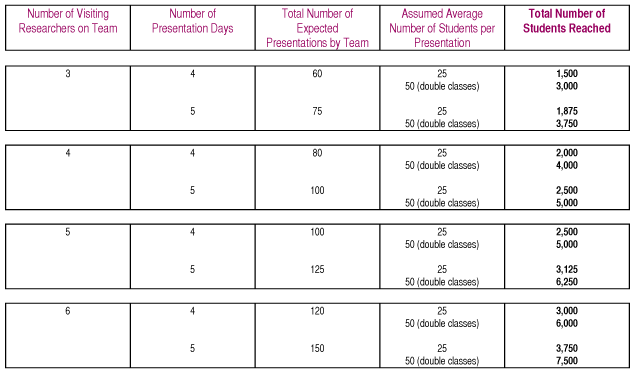 | | |  | There are a number of ways to leverage the impact of the Classroom Visits into a multi-week set of experiences at the schools: 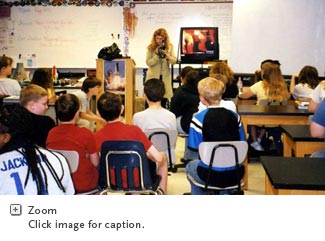 Educator Workshops can be held a few weeks in advance of the Classroom Visits and Family and Public Programs. This provides an opportunity for teachers to be briefed on the full suite of programming, including how best to prepare for the Classroom Visits, and provides training on lessons that can be conducted in advance of the Visiting Researchers arrival, and after they leave. Educator Workshops can be held a few weeks in advance of the Classroom Visits and Family and Public Programs. This provides an opportunity for teachers to be briefed on the full suite of programming, including how best to prepare for the Classroom Visits, and provides training on lessons that can be conducted in advance of the Visiting Researchers arrival, and after they leave. The workshop can include training on a process of science lesson found in the Journey Education Modules, which shows students that they ‘do’ science on a regular basis—and don’t know it. It is great preparation for the Visiting Researcher’s presentation, which places their personal research in the context of the process of scientific inquiry. - Grade-level wide and school-wide activities (a school-wide enrichment model) conducted in advance of the Classroom Visits, e.g., dressing out the school with multidisciplinary Earth and space science projects that integrate research, history, writing, and the arts, and plays and auditorium programs put on by the students. We can assist with a list of ideas for activities and programs. As a creative example of school-wide participation on a single project, imagine each class researching and creating a couple of constellations on paper using glow-in-the-dark paint, and having 44 of them taped to a high auditorium ceiling to recreate the night sky in the northern hemisphere.
When the Visiting Researcher arrives, student ‘docents’ could give them a tour of the projects around the school. One can imagine many weeks of activities across dozens of schools, supported by Journey through the Universe professional development and lessons, and culminating in the Classroom Visits by the Visiting Researchers. | | |  | We are in this together. We will work with the Local Team in your community to define the Classroom Visit program that best suits your needs in terms of effectively reaching your identified student audiences, minimizing the cost, and minimizing logistical preparation and scheduling. We have a suite of tools that can help, including a ‘How-To’ manual providing recipes for Classroom Visit program success; templates for advertising; timelines for coordinating the Classroom Visits, including well-defined milestones; and spreadsheets for developing a daily schedule for each Visiting Researcher, which is no small feat—100 Classroom Visits might require scheduling with dozens of schools and a few hundred teachers, principals, and aids. A Journey through the Universe Program Manager will be assigned to your community, and will be available 24/7 to address all questions and needs, and to coordinate telecons and the flow of information and resources between the National Center for Earth and Space Science Education and your Local Team. The National Team will always be led by a Visiting Researcher from the National Center for Earth and Space Science Education. He/she will serve as the liaison on the ground between the National Team and the community’s Local Team, and will likely have led more than a dozen Team visits to communities across the nation. Our other responsibilities regarding the Classroom Visits: - Assemble the National Team that will travel to your community.
- For each Visiting Researcher, provide you with: 1) a ‘profile’ that includes a bio, a curriculum vita, and a photograph, and, 2) a list of lesson descriptions with grade level appropriateness, and basic AV and other presentation needs identified.
- Arrange all National Team travel to the community, including hotel accommodations, and provide per diem for meals and miscellaneous local travel.
- Classroom Visit assessment: data acquisition, databasing, analysis, and reporting.
|  | There are a number of responsibilities for the community’s Local Team: - Advertising of the program in the schools.
- Arranging the Classroom Visits with the participating schools and teachers, and working closely with our program staff to generate a daily schedule for each Visiting Researcher.
- Sending the Visiting Researchers’ biographies, lesson descriptions, and any needed basic AV and other presentation requirements to the teachers. If the Visiting Researcher needs a computer for a presentation, or any specialized manipulatives, they will bring these items with them. However, their lesson description might include some other basic AV or material needs to be provided by the teacher, such as a screen, access to a white board or chalk board, a ‘boom box’ to play a CD, or availability of a standard-sized classroom globe.
- Assigning a daily ‘Ambassador’ to each Visiting Researcher. The Ambassador picks up the researcher at the hotel, brings them to the appropriate schools and classes, makes sure the Visiting Researcher has access to lunch, and brings the researcher back to the hotel at the end of the day. The Ambassador does not have to stay with the researcher for the entire day, e.g., a ‘morning’ Ambassador could hand off the researcher to an ‘afternoon’ Ambassador. An Ambassador might be a parent, a retired teacher, or some other volunteer from the community. Another option—the school receiving the Visiting Researcher can send a staffer to pick them up in the morning, and drop them off in the afternoon.
However, the most straightforward approach is to find someone that can stay with the Visiting Researcher for the entire week. A Team of 6 Visiting Researchers would therefore require just six dedicated Ambassadors to reach potentially 10,000 students. Some other approaches to consider: - Lunch at the School: You might explore if the school would like to invite the Visiting Researcher to lunch at the school, either with a group of students, or with the teaching staff. It is a great way to extend the experience for the school.
- A Team Breakfast: In Washington, DC, all the Visiting Researchers and Ambassadors would assemble each morning for a breakfast before heading off to the schools. It provided an opportunity for community leaders and representatives from the Local and National Teams to address the entire group, and for everyone to feel the sense of community this program affords.
| | |