|  |  |  Journey through the Universe embraces the notion that student learning extends beyond the formal classroom, with parents and the extended family playing a critical role at home and in myriad other informal learning venues. Journey through the Universe embraces the notion that student learning extends beyond the formal classroom, with parents and the extended family playing a critical role at home and in myriad other informal learning venues.
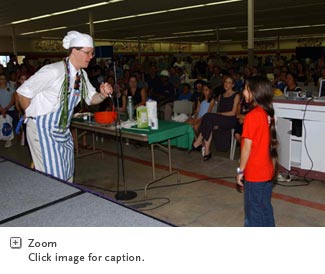
We therefore offer our Visiting Researchers for presentations at Family and Public Programs in your community, each for potentially hundreds of attendees. These are weekday evening or weekend events at local science centers, museums, auditoria, and other appropriate public spaces, where students, parents, and teachers can get together for a community-wide experience in science education. They are scheduled outside of normal school hours, and billed as school ‘fieldtrips’ for family learning. The centerpiece of each program is a presentation—more accurately described as a performance—by a Visiting Researcher. Each community often adds their own program elements, e.g., a potluck dinner; hands-on family science activities before the Visiting Researcher’s presentation and facilitated by local teachers and possibly high school and college students; tours of the venue if it’s a museum or science center; or stargazing afterward courtesy of the local areas astronomers. 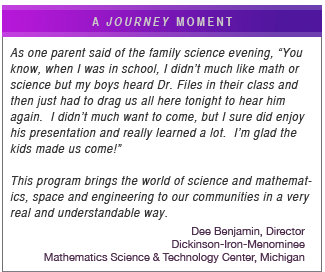 The Visiting Researchers typically conduct one to four of these programs while they are already in your community to deliver a week of Classroom Visits to thousands of students. The idea is to get these students to extend their special experience in the classroom with added programs for their families. It’s also important to encourage the teachers of these students to attend the Family and Public Program so they can connect the experience back to the classroom, and to the Journey through the Universe lessons on which they received training at the Professional Development Workshops. The Visiting Researchers typically conduct one to four of these programs while they are already in your community to deliver a week of Classroom Visits to thousands of students. The idea is to get these students to extend their special experience in the classroom with added programs for their families. It’s also important to encourage the teachers of these students to attend the Family and Public Program so they can connect the experience back to the classroom, and to the Journey through the Universe lessons on which they received training at the Professional Development Workshops.
As with the Classroom Visits, the Visiting Researcher is to provide a very personal window on the art of science, and do it in an engaging manner by facilitating audience participation in telling the researcher’s story. To mate the program to the curriculum, the community can choose from a variety of presentations, all of which are natural extensions of the content of the Journey through the Universe Education Modules. Journey’s Family and Public Programs component was specifically designed to engage students and their parents, empowering ‘the family’ to launch their own sustained journey to the frontiers of knowledge. We can help by providing them a flyer with lists of web sites, national programs, and family resources that they can use to continue their journey. | | |  | 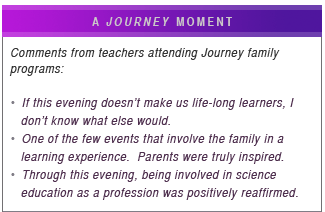 There is no limit on the audience size for Family and Public Programs. In Journey communities from 2000 to 2006, the average total attendance across all Family and Public Programs held during the week of Classroom Visits was 950. There is no limit on the audience size for Family and Public Programs. In Journey communities from 2000 to 2006, the average total attendance across all Family and Public Programs held during the week of Classroom Visits was 950.
A typical attendance for a single program is 100-400. But attendance for single programs in Labette County, Kansas, and Kansas City, Missouri/Kansas, exceeded 1,000. A single program in Nogales, Arizona, drew more than 2,000. In Hilo, Hawai’i, a Sunday afternoon set of events at a local mall drew 2,500. | | |  | The Family and Public Programs component began in 1991 as Family Science Night at the Smithsonian’s National Air and Space Museum. The objective was a science education field trip specifically designed for families. Parents attended with their children, as opposed to serving as chaperones on a typical school field trip. The aim was family learning that provided a window on exciting science content and the process of scientific discovery, and resulted in educational conversations between parent and child in subjects that were seamlessly mated to what the child was learning in school. The program’s success at the Museum (it is still in operation) allowed it to be integrated into the Journey through the Universe program, and appropriately embedded in the Learning Community Model. 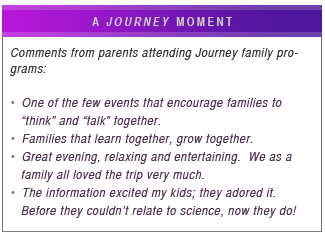 More specifically, the objectives are to: More specifically, the objectives are to:
- Leverage student excitement created by the Classroom Visits by providing researcher-led programs for these students and their families that: engage parents in the education of their children; foster educational conversations between parent and child for weeks after the program; and build a bridge between the schools and the public they serve.
- Provide presentations that in general are relevant to the science curriculum, and in particular address what we know about Earth’s place in space and how we have come to know it.
- Assess the concept of a science program for family learning, and whether families in the community have had such experiences.
- Assess the effectiveness of the program in terms of education value, entertainment value, and shared family experience.
- Determine if the program changes perceptions in both adults and children regarding science and scientists, science education, and space exploration.
The National Center for Earth and Space Science Education conducts assessment of the Family and Public Programs component of Journey through the Universe program. | | |  | A Social Event for Teachers: A family science evening just for teachers and their families, in order to: develop a sense of community spirit and buy-in for the Journey program, generate excitement about the subject matter, and provide a venue for teachers to have a wonderful educational experience with their own families and see first-hand the program impact on their children. Single teachers should be encouraged to bring a date!
Spread the Venues Around: In communities that have a large geographic footprint, or where multiple school districts are involved, it’s useful to hold more than one Family and Public Program, and at venues that maximize both access and sense of community. A Distance Learning Component: Depending on the Visiting Researcher’s presentation, and the availability of local video conferencing equipment, we can explore a live link to a research facility or another appropriate site. A family program in Broken Arrow, Oklahoma, titled An Expedition to the Top of the World, included a real-time video link to scientists at the NASA Infrared Telescope Facility atop 14,000-ft Mauna Kea on the Big Island of Hawai’i. A researcher at the telescope took time from their study of Jupiter’s upper atmosphere to talk to the families. Another live link connected an audience to the Milestones of Flight gallery at the National Air and Space Museum. The chairman of the Museum’s Space History department gave them a tour of the Wright Flyer, Spirit of St. Louis, and Apollo 11. | | |  | 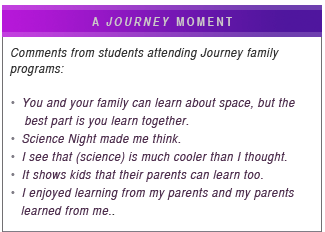 The Family and Public Programs are, first and foremost, advertised by the participating schools as school functions, often held off site at a local museum or science center. It is the means by which these programs serve as an extension of the classroom, and also the means by which parents become vested in attending. The program is also more broadly advertised to the public in order to extend the experiences to the greater community. However, the primary audience remains families, and it is this audience to which the assessment is geared. The Family and Public Programs are, first and foremost, advertised by the participating schools as school functions, often held off site at a local museum or science center. It is the means by which these programs serve as an extension of the classroom, and also the means by which parents become vested in attending. The program is also more broadly advertised to the public in order to extend the experiences to the greater community. However, the primary audience remains families, and it is this audience to which the assessment is geared.
The Visiting Researchers typically fly into a community on a Sunday afternoon, and depart late Friday or Saturday. Their stay can be extended, or they can arrive earlier, if the community would like to hold Family and Public Programs on a weekend. The National Center for Earth and Space Science Education will work closely with your community to deliver the programming schedule that best suits your needs. | | |  | We will work with the Local Team in your community to maximize the experience and attendance at the Family and Public Programs. A ‘How-To’ manual includes recipes for Family and Public Program success; templates for advertising flyers for the schools, and media releases; and timelines for program coordination, including well-defined milestones.
The Journey through the Universe Program Manager assigned to your community for the Classroom Visits programming will be available 24/7 to address all questions and needs for the Family and Public Programs, and to coordinate telecons and the flow of information and resources between the National Center for Earth and Space Science Education and your Local Team. Our other responsibilities: - Identify the National Team members that will be conducting the Family and Public Programs, and provide a description of their presentations for advertising, and their AV requirements.
- Provide a flyer for attendees with lists of family learning resources.
- Provide assessment questionnaires for adult and student attendees in self-addressed envelopes.
- Depending on availability, provide a space poster for every student in attendance.
- Family and Public Program assessment: data acquisition, databasing, analysis, and reporting.
| | |  | There are a number of responsibilities for the community’s Local Team: - Advertising of the Family and Public programs in the schools as a family event, and to the public.
- Obtain the needed venues, and AV equipment.
- Provide roundtrip transportation for the presenters from their hotel to the presentation venue. They will likely have equipment and supplies to transport as well.
- Provide the presenters access to the venue at least 2 hours in advance of the program, and have an AV technician available at that time for assistance in set-up and run-through (sound check, music check if appropriate, and interface of a computer to multimedia displays.)
- Handout assessment questionnaires, and a flyer with lists of family learning resources, to attendees. If available, hand out a space poster to all students in attendance.
| | |