|  | | | Journey through the Universe programs for students, teachers, families, and the public are a window on the nature of science and the lives of modern-day explorers, with special emphasis on not just what is known about our world and the universe but how it has come to be known. This approach reveals the very personal means by which researchers ask questions of the world and empower themselves to create a pathway to an answer. 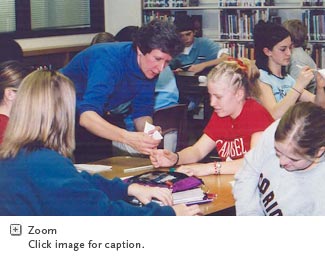 It is a vision recognizing that our understanding of the Universe is far more than just a book of knowledge. Understanding comes from curious people working hard and smart, and ultimately reveling in their ability to pull back the veil of nature and bear witness to something wholly new. If knowledge is the end, then it is the remarkably human journey to that end that embraces imagination and ingenuity and has the power to captivate. And placing the learner within this context of journey provides them a deep appreciation for the book of knowledge, a richer grasp of the content and its conceptual underpinnings, an appreciation of the very human pathway researchers take from question to answer and, in some, will inspire the next generation of engineers and scientists. It is a vision recognizing that our understanding of the Universe is far more than just a book of knowledge. Understanding comes from curious people working hard and smart, and ultimately reveling in their ability to pull back the veil of nature and bear witness to something wholly new. If knowledge is the end, then it is the remarkably human journey to that end that embraces imagination and ingenuity and has the power to captivate. And placing the learner within this context of journey provides them a deep appreciation for the book of knowledge, a richer grasp of the content and its conceptual underpinnings, an appreciation of the very human pathway researchers take from question to answer and, in some, will inspire the next generation of engineers and scientists. This pedagogical approach to science education is embedded in the stories told by the Visiting Researchers—to thousands of students in a community’s classrooms, and at family and public programs; is the core instructional design philosophy for the Journey lessons; and defines how we model best teaching practices during Journey professional development workshops. | | |  | The Power of Heroes We are all born curious. We are all born to learn, and to revel in the act of learning something new. It is so innately human that societies build schools and school systems dedicated to the education of their children. But learning is a very personal experience that can only be empowered by the learner. Teachers and parents may lead the way, creating an immersive environment for learning, but it is a journey that is begun and seen to its conclusion by the learner. It is a journey that each of us is meant to take regularly and throughout life. A journey of personal learning most often begins with inspiration. It may come from others who have been there before us—those who can impart a sense of the human experience. To us, these are our heroes. Their inspiration empowers us to take that first step, to ask that first question— it propels us to discover a world we never knew existed. Our heroes truly have the power to launch us on a remarkable journey. And heroes can come in many different flavors—why not scientists and engineers? What better hero to inspire the next generation of the curious than an engineer figuring out how to build machines to detect other Earths around distant stars, the meteorologist creating sophisticated computer models for hurricane prediction, or the planetary scientist searching for life on Mars? | | | | |  | We believe that Journey through the Universe programming should encompass the continuum of human exploration, including: - explorations of the past and how we have come to our current understanding of our world and the Universe, in order to celebrate human achievement;
- present day explorations, providing relevance to our time through participation by the research community and the use of current news as teachable moments; and
- a look to the future, to reveal the nature of debate on the current scientific frontier, and glimpse what awaits the next generation.
|  | | We believe that our science education programs must first inspire—provide an ‘Oh Wow’ experience that is both emotional and personal, most often through authentic experiences with researchers who live on the frontiers of human understanding. We also believe that inspiration alone is not enough. We recognize the power of inspiration as a gateway to richer educational experiences. The embraced educational paradigm is— |  | Good science education must therefore provide opportunities for students to slip on the shoes of the researcher and experience scientific exploration through personal involvement. We believe that ‘Learner as Explorer’ is truly the only way to develop an understanding of science, and an appreciation for how naturally it grows from innate human curiosity. More generally, we want to help equip the student with the skills necessary to be a self-motivated, effective, life-long learner, and one who can revel in the endeavor of exploration. It is teachers of science that can enable these kinds experiences for students on a daily basis. Through professional development programs for the community’s educators—programs that embrace the teacher as a facilitator of inquiry-based exploration in the classroom—Journey through the Universe provides training on compendia of grade K-12 lessons instructionally designed to embrace scientific exploration in the classroom. | | |